In today’s distraction-filled world, many people struggle to feel present and fulfilled. Even with all of the entertainment, social media, and technological conveniences available to people, they report increasingly high levels of boredom (Tam & Inzlicht, 2024). One reason for this is that mindless scrolling and passive media consumption can leave a person’s mind in a mental state that lacks direction and purpose. This is sometimes referred to as the mind’s default state—where the mind wanders from thought to thought without focused direction. Unfortunately, in this state the mind also eventually tends to gravitate toward worry, stress, and dissatisfaction (Killingsworth & Gilbert, 2010). This has important implications for mental health because developing a habit of being in the default state means that a person might be more vulnerable to certain mental health concerns.
There are lots of great ways to address distracted living and boredom, and one powerful way is flow: a state of deep, active focus where a person’s attention is fully immersed in the present moment (Csikszentmihalyi, 1997; Nakamura & Csikszentmihalyi, 2002). In flow, a person’s abilities to perform a task are a perfect match for the task at hand.
The good news? When people engage in activities that encourage flow, they are more satisfied in the present moment, while also experiencing improved mental health outcomes, reduced stress, and increased overall happiness (Csíkszentmihályi, 1990).
This guide introduces the concept of flow and provides exercises to help you understand and increase it in your life.
What Is Flow and Why Does It Matter?
Flow pulls the mind out of its default mental state, anchoring attention in an activity that is fulfilling and invigorating because it demands focus and attention. In a culture where mental health concerns are rising, learning to cultivate flow offers a way to reconnect with purposeful and enjoyable activities. Whether it’s through hobbies, creative pursuits, or meaningful work—experiencing flow provides a natural, intrinsically rewarding experience of the present moment.
Examples of flow can be found across many types of activities:
- An athlete like Serena Williams at the peak of her performance, where each tennis stroke feels intuitive and fluid.
- A jazz musician like Joshua Redman fully engaged in improvisation, feeling as though the music is pouring out effortlessly.
- A writer like Stephen King becoming so absorbed in the creative process that hours pass unnoticed.
These moments of flow share a key trait: they balance a person’s abilities with challenge, creating an experience that is both engaging and satisfying. Pursuing flow helps individuals break free from unfulfilling patterns of distraction, replacing passive time with active, fulfilling engagement.
| Example Flow Activities | Description |
| Example: Playing guitar | Practicing a new song |
| Example: Writing | Drafting a blog post or story |
| Example: Exercise | Running or biking at a challenging pace |
| Example: Cooking | Trying out a new recipe |
| Example: Puzzles | Solving a challenging crossword or logic puzzle |
Exercise 1: Activity Brainstorming
List 5-7 activities you do regularly (both for work and leisure). Think about tasks that vary in difficulty and your ability to perform them.
| Activity Name | Description |
| 1. | |
| 2. | |
| 3. | |
| 4. | |
| 5. | |
| 6. | |
| 7. |
Exercise 2: Activity Mapping
Place your activities into the appropriate zones based on your skill level and the challenge they present:
Skill Level: How skilled are you at this activity? (Low to High)
Challenge Level: How challenging is the activity for you? (Low to High)
An easy way to do this: just write down the activity on the place on the chart. For example, for me I would write playing the guitar in the CONTROL section because I am pretty good at guitar but also don’t tend to challenge myself too much either.
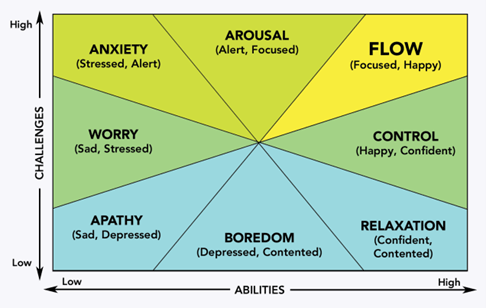
For each activity you came up with, write its name and place it in one of the following emotional zones:
| Emotional Zone | Description | Activity |
| Flow | High Skill, High Challenge | |
| Control | High Skill, Medium Challenge | |
| Relaxation | High Skill, Low Challenge | |
| Arousal | Medium Skill, High Challenge | |
| Anxiety | Low Skill, High Challenge | |
| Worry | Low Skill, Medium Challenge | |
| Boredom | Medium Skill, Low Challenge | |
| Apathy | Low Skill, Low Challenge |
Exercise 3: Reflecting on Your Experiences
Reflect on where your activities fell in the mapping exercise. Use the prompts below to guide your reflection:
Which activities help you feel fully absorbed?
____________________________________________
Are there activities that frequently lead to anxiety or boredom? Why?
____________________________________________
How might you adjust the challenge or skill level of these activities to improve your experience?
____________________________________________
Exercise 4: Creating an Action Plan for More Flow
Once you’ve identified activities that can bring you into a flow state, creating an intentional action plan can help you experience flow more regularly.
Step 1: Identify Key Flow Activities
Select 2-3 activities with the most potential to bring you into flow.
What are 2-3 activities you want to enhance?
Activity 1: __________________
Activity 2: __________________
Activity 3: __________________
Step 2: Adjust Skill or Challenge Levels as Needed
Flow is most likely when there’s an optimal balance between challenge and skill. Some activities may need small adjustments to make them more enjoyable and suited for flow. For tasks that tend to cause frustration or boredom, think about how you could either improve your skill level (through practice or learning) or modify the difficulty to reach the optimal challenge-skill balance.
If a task feels too easy, add complexity, like experimenting with more advanced recipes if you enjoy cooking. If it’s too hard, consider breaking it down into smaller, manageable parts.
A couple examples:
Example 1: If you’re a musician who is highly skilled, you may sometimes feel control or relaxation when playing rather than flow. One adjustment is to increase the challenge of the task, e.g., try learning a slightly more difficult piece or a scale.
Example 2: If you’re a writer who sometimes feels stress or anxiety rather than flow, one adjustment is to change the difficulty of some of the writing tasks. For example, you may want to include some creative writing activities
What changes could you make to the activity to better balance skill and challenge?
| Activity | Current Zone | Adjustment to Improve Flow |
| 1 | ||
| 2 | ||
| 3 |
Step 3: Create Dedicated Time Blocks
Flow requires focused attention, which is difficult to achieve with constant interruptions. Establish dedicated time for each activity you want to enhance for flow, minimizing potential distractions.
Example: If you’re working on writing, set aside 30 minutes each morning as your distraction-free time for that activity.
When and where can you dedicate time to this activity, minimizing interruptions?
| Activity Name | Dedicated Time and Place |
| 1 | 1 |
| 2 | 2 |
| 3 | 3 |
Step 4: Set Specific Flow Goals
Creating measurable goals can help you track your progress and stay motivated. Decide on a specific goal that supports your flow journey, such as aiming to experience flow a certain number of times per week or focusing on achieving flow for a set duration.
Example: “I will aim to experience flow at least twice a week while practicing piano for 30 minutes each session.”
What specific flow goals would you like to achieve?
| Activity Name | Flow Goal |
| 1 | 1 |
| 2 | 2 |
| 3 | 3 |
A Few More Resources to Explore
Books
Csikszentmihalyi, M. (1996). Creativity: Flow and the Psychology of Discovery and Invention.
HarperCollins. https://www.harpercollins.com/products/creativity-mihaly-csikszentmihalyi?variant=32205941211170
Newport, C. (2016). Deep Work: Rules for Focused Success in a Distracted World. Grand
Central Publishing. https://www.hachettebookgroup.com/titles/cal-newport/deep-work/9781455586691/?lens=grand-central-publishing
Online Communities
Reddit Community: r/FlowStates
Reddit Community: r/PeakPerformance
 Dan Lannin
Leave a comment